
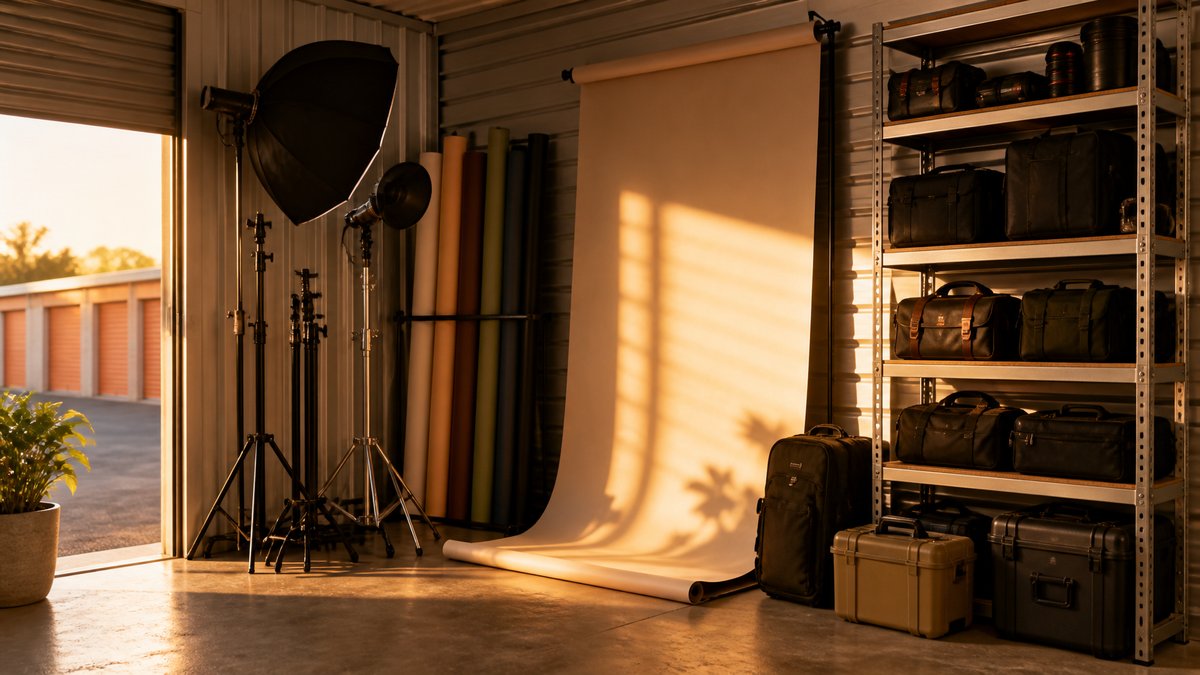
Whether you’re a seasoned photographer or just starting your videography journey, you know that gear is your lifeline. Cameras, lenses, lights, backdrops, and stands are not just tools—they’re investments. But they can also take over your home or office. Between shoots, where do you put everything? Cluttered spaces invite accidents, dust, and humidity. That’s where a dedicated storage unit can be a game-changer.
Separate equipment storage from your home working space only when a suitable unit is available. Confirm the conditions your equipment requires before moving it.
Let’s talk about what to store and how to store it. Your backdrops are often large and awkward. Rolling them up and placing them in a unit is easy, but you need to protect them from creases and dust. Use a dedicated backdrop tube or wrap them in acid-free paper. Stand them upright in a corner, and you’ll save floor space. If you have multiple backdrops, label each tube so you can grab the right one in seconds.
Lights are another big item. Softboxes, strobes, and continuous lights are bulky and fragile. Break them down as much as possible and pack each piece in its original case or a padded bag. Place heavier items on the bottom, lighter ones on top. Avoid stacking softboxes under heavy gear—they can bend or crack. A storage unit with open floor space lets you organize by type, making load-in and load-out faster.
Atlas Self Storage does not offer climate-controlled units at either Penn Hills or North Hills. Check your belongings’ care instructions for temperature and moisture requirements before deciding whether these units are suitable.
One of the biggest advantages of a storage unit is having a dedicated space to prep and pack. You can lay out your gear the night before a shoot, check your checklist, and load your car without tripping over stuff at home. This saves you time and reduces the chance of forgetting something critical.
Atlas Self Storage has locations in Penn Hills and North Hills. Contact your preferred location to confirm current unit options, dimensions, access hours, features, rental terms and availability. Plan collection times around confirmed access hours.
When you’re ready to organize your unit, start by creating zones. Designate an area for backdrops, another for light stands, and a shelf for smaller boxes. Use shelving units to maximize vertical space—this is a great way to keep things off the floor and reduce clutter. Label everything clearly. A simple label maker or colored tape can make a huge difference.
A suitable hand truck can help move packed cases. Confirm loading access, surface conditions and any equipment restrictions with the location.
Ask your chosen location about its current access controls, lighting, surveillance, lock requirements and coverage options. Features can differ by location and unit; no security measure guarantees against loss.
Finally, think about the future. As your business grows, you might add more gear. A storage unit gives you room to expand without moving to a larger space or renovating your home. And when you’re between shoots, you can relax knowing your equipment is safe and ready.
Use the Storage Space Calculator to add catalog items or custom dimensions and quantities. Its recommendation is a planning estimate, not a guarantee of fit, suitability, price or availability. Confirm the selected unit and your packing plan with the location.
MAKE ROOM FOR WHAT’S NEXT.
Use the calculator for a planning estimate, then confirm your needs with your location.
Check unit listings and contact the team at Penn Hills or North Hills.
Find your location →