
If you manage commercial storage—extra inventory, fixtures, files, or equipment—you've probably sized a unit the old way: grab a tape measure, pace out a room, and hope your math holds up. It works, but it's slow and easy to get wrong. Here's why a digital planning tool is the better starting point for commercial space.
**The tape measure method has a hidden cost.**
Measuring by hand feels concrete. You get real numbers. But commercial storage involves *many* items—stacks of boxes, pallets, shelving, odd-shaped equipment. Measuring each one, converting units, and sketching a floor plan eats hours. Worse, small errors compound. A mismeasured pallet footprint or a forgotten aisle can leave you paying for space you can't actually use—or cramming items into a unit that's too small.
**A calculator handles the math and the mess.**
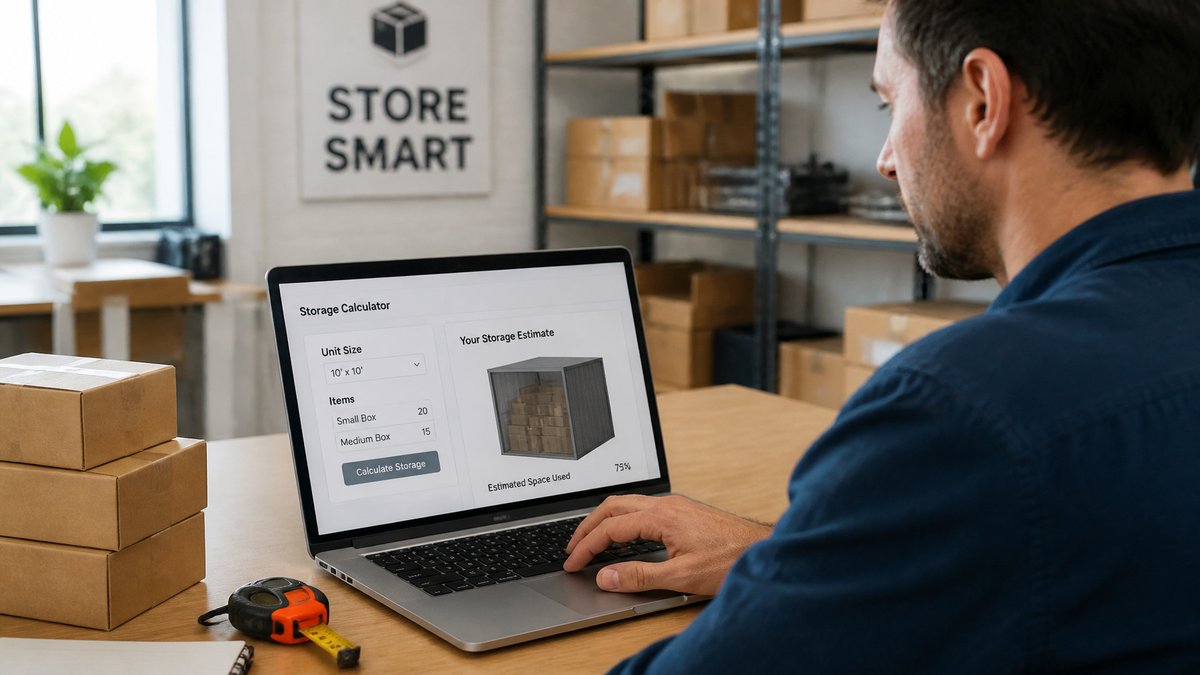
The Storage Space Calculator lets you add catalog items or enter custom dimensions and quantities. Instead of measuring every box, you describe what you have and let the tool total it up. It then applies a 40% allowance—breathing room for aisles, stacking gaps, and access—so your estimate reflects real-world use, not a perfect Tetris fit. For commercial users juggling mixed inventory, that's a big time-saver.
**Digital planning is easier to adjust and share.**
When your inventory changes—a new shelving run, a seasonal pallet surge—re-measuring by hand means starting over. With a calculator, you update quantities and get a revised estimate in seconds. That flexibility matters for businesses whose storage needs shift. It's also easier to share a clear estimate with a colleague or decision-maker than to explain a hand-drawn sketch.
**What the calculator won't do.**
Be clear-eyed here: the calculator provides a *planning estimate*, not a guarantee. It does not guarantee fit, savings, or availability, and it doesn't filter live inventory or reserve a unit. Treat its output as a smart starting point, then confirm the specifics with your chosen Atlas location—Penn Hills or North Hills. Each has its own published listings, and availability, unit types, and policies should be confirmed directly.
**A quick illustrative example.**
Say a small business has 30 medium boxes, two shelving units, and a pallet of fixtures. Measuring each by hand takes time and invites error. Entering those items into the calculator—clearly an illustrative scenario, not a promise of fit—gives a fast estimate with the 40% allowance built in. From there, you can sanity-check the number against what you actually see.
**Where the tape measure still earns a spot.**
A tape measure is still handy for confirming a specific doorway width, ceiling height, or the exact size of one oversized item. Use it to verify details—not to plan the whole layout from scratch. The digital estimate does the heavy lifting; the tape measure fine-tunes.
**Keep the rules in mind.**
Atlas's two Pittsburgh locations—Penn Hills and North Hills—offer 24-hour tenant access, video surveillance, and clean, well-lit facilities. Note that neither location offers climate-controlled storage. Tenant access is separate from office hours, so call to confirm office times. Policies like pricing, discounts, lease terms, and permitted uses aren't confirmed here—ask your chosen location directly. And remember: renting a unit isn't permission to run a workshop, rehearse, receive customers, or operate tools; those activities need express facility permission.
**The bottom line.**
For commercial storage, digital planning beats the tape measure for speed, accuracy, and flexibility. Start with a planning estimate, then verify the details with the location you're considering.
Ready to size your space smarter? Use our Storage Space Calculator for a planning estimate, then confirm fit and availability with your chosen Atlas location.
MAKE ROOM FOR WHAT’S NEXT.
Use the calculator for a planning estimate, then confirm your needs with your location.
Check unit listings and contact the team at Penn Hills or North Hills.
Find your location →